If you're applying for MEPCO net metering today, you're not actually getting "net metering" in the old sense — you're getting net billing, and the two behave very differently on your bill.
Since NEPRA notified the Prosumer Regulations, 2026 on February 9, 2026, exported and imported electricity are priced separately instead of swapped one-for-one.
If your agreement was signed before that date, you're grandfathered in under the old terms until your contract expires.
That's the headline. The rest of this guide covers what it means in practice: how your bill gets calculated now, what documents MEPCO wants, realistic costs and timelines, and — because most guides skip this part — how to size a system and estimate payback before you spend a rupee.
Quick Answer
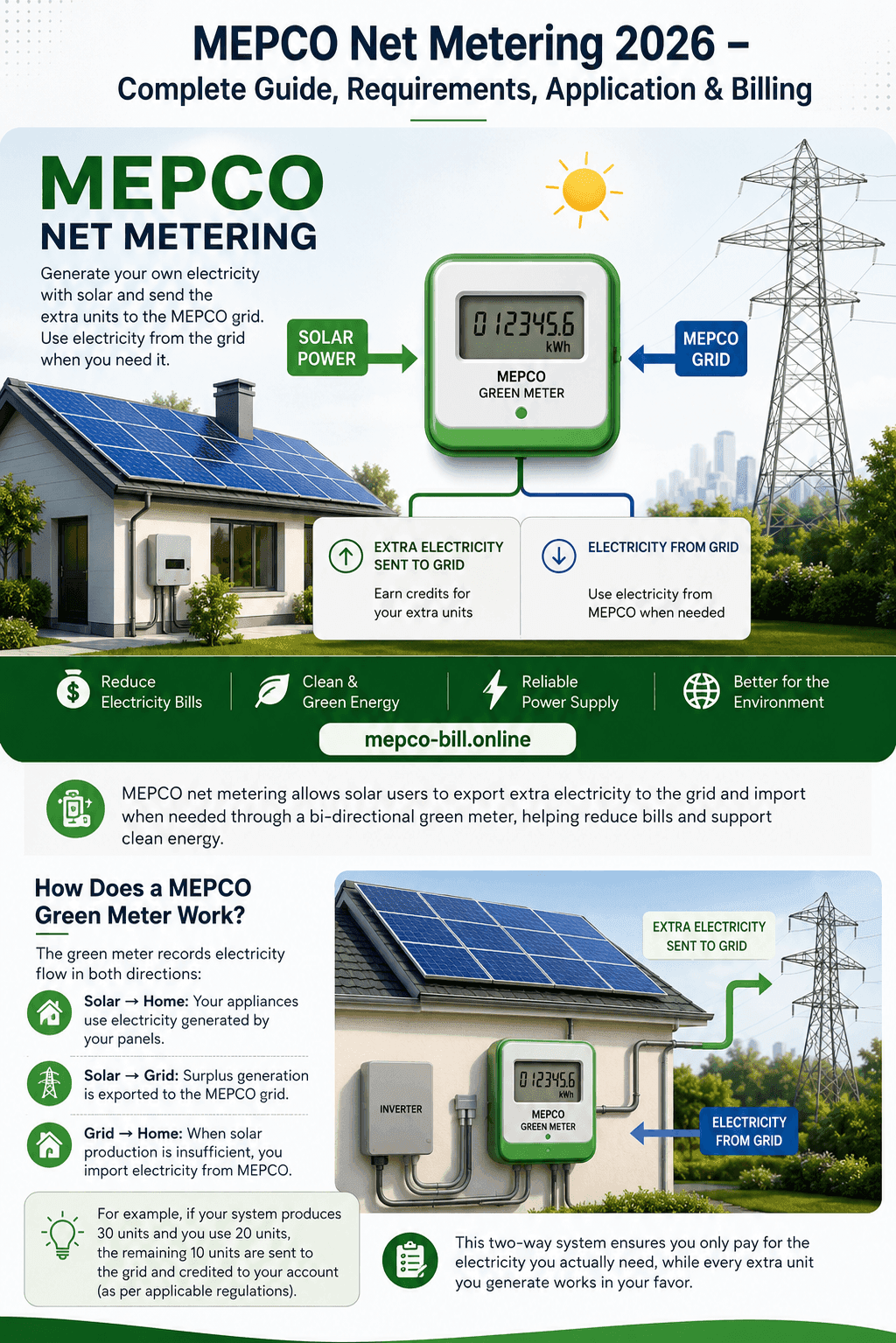
A green meter is what makes any of this possible. It's a bidirectional meter that separately tracks the electricity your solar panels push into the grid and the electricity you pull back out when the sun isn't cooperating.
Until February 2026, MEPCO simply cancelled those two numbers against each other — send 10 units out, pull 10 units back, and you owed nothing for them.
Under net billing, that clean cancellation is gone. You pay for what you import at the retail rate and get credited separately for what you export at a lower buy-back rate, so the two no longer wash out evenly.
The 2026 Policy Shift: Net Metering vs. Net Billing
This is the part most articles gloss over, and it's the part that actually affects your wallet.
Under the old net metering framework, every exported unit cancelled an imported unit later, dollar for dollar (or rather, rupee for rupee).
Send 10 units to MEPCO in the afternoon, pull 10 back at night, and your net bill for those units was zero.
Under net billing, exported and imported electricity stop being interchangeable. What you send to the grid gets purchased from you at one rate. What you draw from the grid gets sold to you at MEPCO's normal retail rate.
Since those two rates aren't the same number, exporting a unit no longer automatically wipes out the cost of importing one.
- Existing consumers are largely protected. After public pushback following the February 9 notification, NEPRA issued a follow-up confirming that approvals, licenses, and agreements signed under the old rules before that date stay valid until they expire.
- There was a grace window for pending applications. If your paperwork was already submitted before February 8, 2026 but hadn't been processed yet, it's still handled under the old net-metering policy.
- Fresh applications fall under net billing, full stop. If you're applying today, you're in the Prosumer Regulations 2026 framework, not the old 1:1 system.
- The details are still being argued over. Through 2026 there has been ongoing back-and-forth between the Power Division, NEPRA, and solar consumer groups.

What Is an MEPCO Green Meter?
It's the piece of hardware that makes either system work. The meter separately records:
- Electricity your panels send into the grid (export)
- Electricity you pull from the grid when solar output isn't enough (import)
Without it, MEPCO has no way to tell "power you generated and used yourself" apart from "power you generated and sold back" apart from "power you simply bought."
Who's Eligible for MEPCO Net Metering?
- A three-phase connection. Single-phase consumers have to upgrade at their local MEPCO office first.
- An active MEPCO connection with no outstanding dues.
- Solar capacity that doesn't exceed your sanctioned load.
- Installation through an AEDB-approved installer.
- Total generation capacity under 1 MW.
Documents You'll Need
| Document | Notes |
|---|---|
| CNIC (applicant + witnesses) | Must match the name on the electricity bill |
| Latest paid MEPCO bill | Confirms no outstanding dues |
| Distributed Generation Interconnection Agreement | Standard MEPCO/NEPRA form |
| NEPRA license application | Filed alongside the interconnection agreement |
| Affidavit (on stamp paper) | Confirms compliance with Prosumer Regulations 2026 |
| Technical specs of panels & inverter | Include inverter serial number and datasheet |
| Single-line diagram | Prepared by a licensed electrical engineer |
| Site plan | Shows physical layout |
| Installer agreement | With your AEDB-approved installer |
Step-by-Step: How to Apply
- Check your sanctioned load and connection type.
- Pick an AEDB-approved installer.
- Prepare your documents using the checklist above.
- Submit the application through MEPCO.
- Complete the site inspection.
- Sign the agreement and get regulatory sign-off.
- Install the green meter and activate the connection.

How Your Bill Is Actually Calculated
The biggest financial mistake people make is assuming exported units simply cancel imported units, one for one — that assumption breaks down fast under net billing, which is now the default for new applicants.
Old net metering logic (grandfathered consumers only): Bill = (Units imported − Units exported) × retail rate, plus fixed charges and taxes.
New net billing logic (new applicants): Bill = (Units imported × retail purchase rate) − (Units exported × grid buy-back rate), plus fixed charges and taxes.
Take a household that imports 400 units and exports 250 units in a billing cycle. Under the old system, that nets out to 150 payable units — simple. Under net billing, you pay for all 400 imported units at the retail rate, then get a separate credit for the 250 exported units at the lower buy-back rate.
Sizing Your Solar System Properly
Oversizing used to be a mildly wasteful decision. Under net billing, it's a much more expensive one.
A simple starting formula:
Daily solar output needed (kWh) ≈ Average daily units consumed × 1.1
Panel capacity (kW) ≈ Daily output needed ÷ average peak sun hours
A household averaging 20 units a day is probably looking at something in the 4–5 kW range — not a 10 kW system "to be safe."
Common Mistakes to Avoid
- Assuming free electricity
- Oversizing "to be safe"
- Skipping the AEDB-approved installer requirement
- Mismatched names on CNIC vs. electricity bill
- Exporting before activation
Frequently Asked Questions
Is old-style net metering completely gone?
No. Consumers with agreements executed before February 9, 2026 keep their existing terms until those agreements expire.
Can I still apply if I have a single-phase connection?
You'll need to upgrade to three-phase at your local MEPCO office first.
Does net billing mean solar is a worse investment now?
Not necessarily. It changes how you save, not whether you save.
Do I need battery storage?
Not required, but it can be worth considering if your household uses more power in the evening than during the day.
Final Thoughts
MEPCO net metering isn't the simple 1:1 swap it used to be. If you're a new applicant, plan around net billing: size your system to your actual consumption rather than your available roof space, and get the specific buy-back rate and terms in writing before you commit to anything.
If you already have solar and signed before February 9, 2026, your existing terms should carry through as-is — but it's worth checking NEPRA's notifications periodically anyway.
This article is for general information and reflects publicly available regulatory notifications as of August 2026. Net metering and net billing rules, rates, and fees are subject to change — always confirm current terms directly with MEPCO or NEPRA before making a financial decision.